
Newcastle Disease: Prevention & Treatment for Ghanaian Poultry Farmers
Newcastle disease is the number one killer of poultry in Ghana - and the most preventable. This guide covers symptoms, vaccination, biosecurity, outbreak response, and when to call the vet.
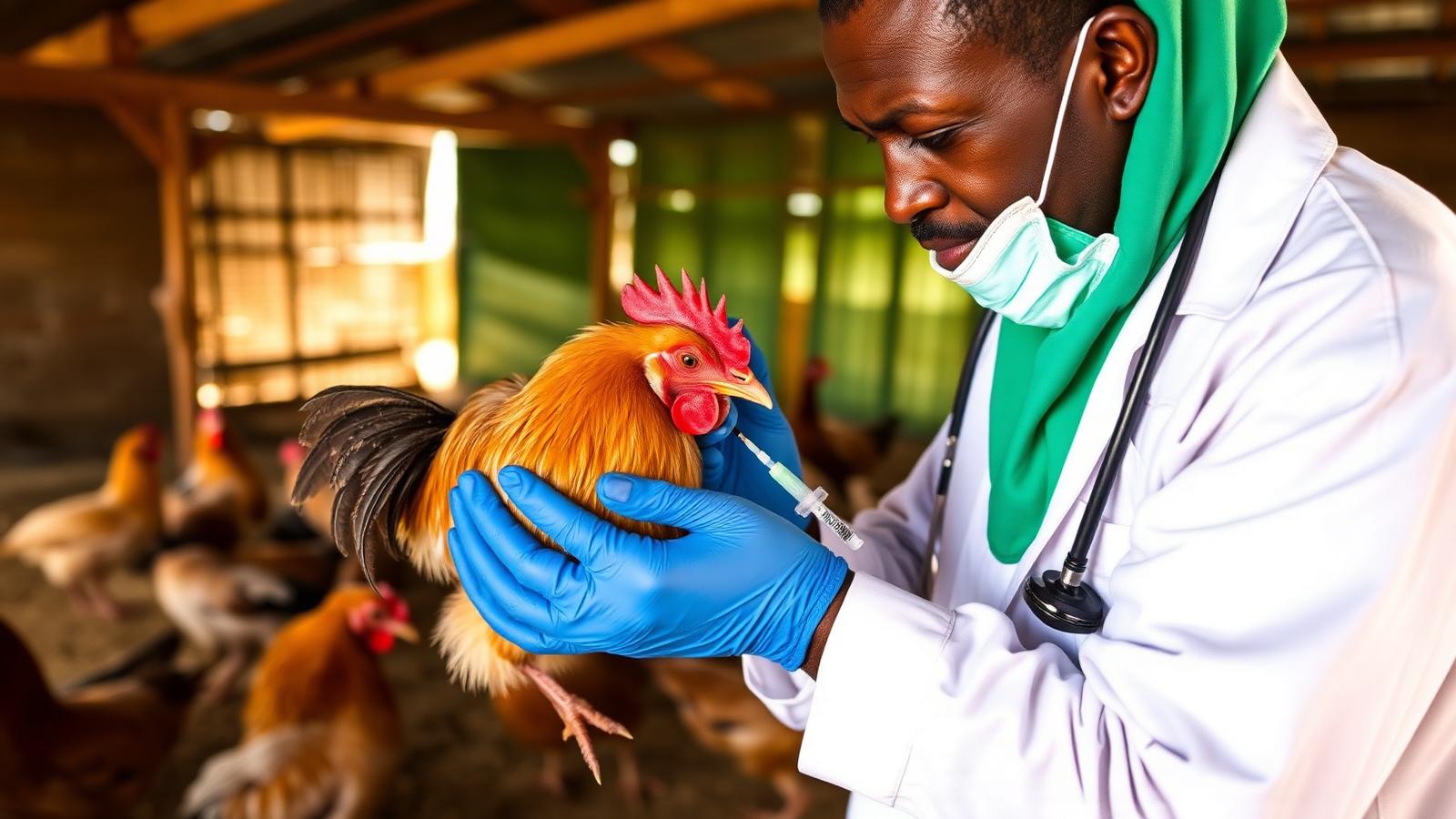
What Newcastle disease is
Newcastle disease (ND) is a highly contagious viral infection caused by Avian orthoavulavirus 1. It affects chickens, turkeys, guinea fowl, pigeons and wild birds. In Ghana it is the single largest cause of poultry death, and outbreaks routinely wipe out entire rural flocks overnight.
The virus spreads through infected birds, contaminated feed and water, wild birds (especially pigeons and doves), boots, tools, feed sacks, and even wind over short distances. Once ND is in a coop, the mortality rate in an unvaccinated flock can hit 90-100% within 5-7 days.
Symptoms you must recognise
ND shows in three overlapping forms - respiratory, digestive, and nervous. In a Ghanaian rural flock you will typically see a mix.
- Sudden deaths with no warning, especially overnight.
- Greenish, watery diarrhoea - the most classic early sign.
- Gasping, sneezing, nasal discharge, birds stretching necks to breathe.
- Twisted neck (torticollis), walking in circles, paralysis of legs or wings - the nervous form.
- Sudden drop in egg production in layers, often with soft-shelled or misshapen eggs.
- Swollen face and eyes, dark comb and wattles.
If you see any three of these together, assume Newcastle until a vet says otherwise. Act the same day.
Why it wipes out whole flocks
Three things make ND uniquely destructive in Ghana:
- No cure exists. Once a bird is infected, antibiotics and vitamins can only support survivors - nothing kills the virus.
- Mixed backyard flocks. Chickens, guinea fowl, ducks and pigeons sharing the same compound let the virus circulate and mutate.
- Free-ranging birds contact wild birds and neighbours' flocks daily. A single infected pigeon can seed an outbreak across three villages.
The good news: a working vaccination programme prevents nearly all commercial losses. Ghana has had proven thermotolerant vaccines available for decades. Farmers who lose flocks to ND almost always missed a dose.
Working vaccination schedule
Use this schedule for broilers, layers and backyard chickens in Ghana. All vaccines are available through Veterinary Services Directorate offices and licensed agrovet shops.
Broilers (short-cycle meat birds):
- Day 7 - Lasota or I-2 vaccine (eye drop or drinking water)
- Day 21 - Lasota booster (drinking water)
Layers and breeders:
- Day 7 - Lasota or I-2 (eye drop)
- Day 21 - Lasota booster (drinking water)
- Week 8 - Lasota or killed vaccine (injection)
- Week 18 - Killed ND vaccine (injection, before point of lay)
- Every 8-12 weeks thereafter - Lasota (drinking water)
Backyard / free-range flocks: the I-2 thermotolerant vaccine was developed for rural African conditions - it stays effective without a refrigerator for several days. Administer by eye drop every 3-4 months. This single vaccine is the highest-impact intervention available to rural Ghanaian poultry farmers.
Never vaccinate sick birds - it will not work and can accelerate deaths. Vaccinate only healthy flocks, ideally early morning when it is cool.
Biosecurity that actually works
Vaccination reduces the odds of infection but does not eliminate them. These simple biosecurity habits close most of the remaining gap - and they cost almost nothing.
- Footbath at the coop door. Fresh disinfectant (Virkon-S, iodine, or 1% bleach) refilled weekly.
- Dedicated coop boots. Never wear the same boots into the coop that you wore at the market.
- No visits between farms during outbreaks. A neighbour who lost birds yesterday should not walk into your coop today.
- Quarantine new birds for 21 days before mixing them with your flock.
- Control wild birds. Cover feed stores, cover water troughs, and stop pigeons roosting on the coop roof.
- All-in / all-out flocks. Clean and rest the coop for 14 days between batches - break the disease cycle.
What to do during an outbreak
If you suspect Newcastle in your flock, act within hours, not days.
- Isolate the coop immediately. Nobody in or out except one caretaker. Change footwear at the door.
- Call your district Veterinary Services officer or a licensed vet. Confirm the diagnosis - Newcastle looks similar to Avian Influenza and Infectious Bronchitis.
- Do not sell or move any birds during a suspected outbreak. Selling sick birds spreads the virus across markets.
- Burn or deep-bury dead birds at least 1 metre deep with lime. Never throw carcasses to dogs or into bush.
- Support survivors with clean water, electrolytes and multivitamins. Antibiotics do not treat ND but can prevent secondary bacterial infections.
- After the outbreak passes, depopulate any survivors that show nervous signs, clean and disinfect the coop thoroughly, and rest for at least 21 days before restocking.
Reporting and vet services
Newcastle disease is a notifiable disease in Ghana. If you suspect an outbreak, report to your District Veterinary Services Directorate office. Early reporting protects your neighbours' flocks and gives you access to official response support and vaccination programmes.
Keep the phone number of at least one local vet and one district vet officer saved before you ever need it. In an outbreak the difference between calling on day 1 and day 3 is often the difference between losing 20% of the flock and losing all of it.
Your next steps
Do these three things this week:
- Confirm every bird in your flock is on the vaccination schedule above. If not, book the next dose.
- Set up a footbath at your coop door and buy a pair of dedicated coop boots.
- Save your district vet officer's phone number in your phone and in a note by the coop door.
Log every vaccination, mortality and vet visit in FamRite. Ask questions in AgroChat #ask-a-vet and #poultry - Ghanaian poultry farmers and vets answer daily.
Frequently asked questions
Is there a cure for Newcastle disease in chickens?
No. Once a bird is infected there is no cure - antibiotics and vitamins can only support survivors against secondary infections. Prevention through vaccination and biosecurity is the only reliable protection.
Which vaccine works best for Newcastle disease in Ghana?
For commercial flocks, Lasota (live) with a killed booster at 18 weeks. For backyard and rural flocks, the I-2 thermotolerant vaccine is ideal because it stays effective without refrigeration and is administered as an eye drop every 3-4 months.
How can I tell if my chickens have Newcastle disease?
Watch for greenish watery diarrhoea, gasping and neck stretching, sudden deaths overnight, twisted necks or circling, and a sudden drop in egg production with misshapen eggs. If you see any three together, assume Newcastle and isolate the coop the same day.
How does Newcastle disease spread?
Through infected birds, contaminated feed and water, wild birds (especially pigeons), boots and tools, feed sacks, and short-distance airborne particles. Free-ranging flocks and mixed backyard flocks are at highest risk.
Can humans catch Newcastle disease from chickens?
Humans very rarely develop mild conjunctivitis (eye redness) from close contact with infected birds - it clears on its own. Newcastle is not a serious human health risk, but the economic loss to poultry farmers is severe.
Run your farm with FamRite
Track flocks, log expenses in GH₵, and get answers from the FamRite community - all in one app.